
A warehouse cleanout can uncover more than old inventory and unused equipment. In Maple Ridge, businesses may discover chemical products that have been sitting in storage for years—sometimes without clear labels, current documentation, or an obvious disposal plan.
These chemicals may have been purchased for maintenance, cleaning, manufacturing, equipment servicing, construction work, or previous business operations. Over time, products can become expired, obsolete, partially used, or simply forgotten.
The important question is not just “How do we get rid of these chemicals?”
The better question is:
What are the materials, how should they be handled, and which waste stream is appropriate for each one?
For a commercial warehouse, discovering years of unused chemicals should trigger a controlled waste-management process rather than an immediate cleanup attempt.
Why Do Warehouses Accumulate Unused Chemicals?
Chemical products can remain in commercial storage areas for years for several reasons.
A business may have:
- Discontinued a particular production process
- Changed cleaning products
- Replaced equipment
- Updated maintenance procedures
- Closed a department
- Purchased more material than required
- Acquired inventory from another company
- Inherited materials from a previous tenant
- Stored emergency or backup supplies
- Changed suppliers or product formulations
As business operations change, chemical products can become obsolete without anyone noticing.
A warehouse may continue using the active inventory while older containers remain untouched at the back of a storage room.
Years later, those products become a waste-management issue.
Why Old Chemicals Should Not Be Treated Like Ordinary Warehouse Waste
An old chemical container is not automatically safe simply because it has been sitting untouched.
Age can affect the condition of both the product and its container.
Depending on the material, businesses may encounter:
- Corroded containers
- Damaged caps
- Faded labels
- Leaking containers
- Deteriorated packaging
- Unknown contents
- Expired products
- Separated or degraded materials
The actual risk depends on the chemical and its condition, but uncertainty itself is a reason to avoid unnecessary handling.
Businesses should not assume that an old chemical can be poured down a drain, placed into general garbage, or combined with another waste stream.
The First Step Is Inventory, Not Disposal
When years of unused chemicals are discovered, the first step should be to establish what is actually present.
Businesses can create an inventory that records:
- Product name
- Manufacturer
- Container size
- Approximate quantity
- Existing label information
- Product or batch number
- Container condition
- Storage location
- Available Safety Data Sheet (SDS)
- Whether the product is expired or discontinued
This information helps distinguish known chemical products from unidentified materials.
It also gives a professional waste-management provider better information when planning collection.
What If the Chemical Has No Label?
Unlabelled containers require additional caution.
A business should not try to identify an unknown substance by opening it, smelling it, mixing it, or conducting an informal test.
Instead, keep the container isolated and investigate whether the business has historical records that could identify the material.
Useful sources may include:
- Old purchasing records
- Supplier invoices
- SDS files
- Previous inventory lists
- Maintenance records
- Production documentation
- Information from former employees or facility managers
If the contents still cannot be confidently identified, professional guidance should be obtained before further handling.
What If the Container Is Leaking?
A leaking or deteriorating container should be treated as a higher-priority issue.
Businesses should avoid moving a compromised container unnecessarily unless they have the appropriate procedures and equipment to do so safely.
Information about the condition should be communicated when arranging professional assistance.
A waste-management provider should know if the facility contains:
- Leaking containers
- Corroded drums
- Damaged packaging
- Strong chemical odours
- Unknown substances
- Containers stored in unstable conditions
This allows the collection process to be planned around the actual condition of the material.
Why Mixing Old Chemicals Can Make the Problem Worse
A warehouse may contain several different chemical products, but that does not mean they can be combined.
Different chemicals can have different physical and chemical properties.
Mixing materials without understanding their compatibility can create unnecessary risks and can also make the resulting waste stream more difficult to identify and manage.
For this reason, businesses should keep different chemical products separated until their appropriate waste-management route has been determined.
This is particularly important when dealing with:
- Solvents
- Cleaning chemicals
- Oils
- Paint products
- Acids
- Alkaline products
- Aerosols
- Chemical residues
- Unknown liquids
The objective is to preserve information about each waste stream rather than turning multiple known and unknown materials into one unidentified mixture.
What Happens to the Chemicals After Identification?
Once the materials are identified, the next step is determining the appropriate management route.
Some products may potentially be:
- Returned to a supplier
- Reused where permitted and appropriate
- Recycled
- Recovered
- Sent for specialized treatment
- Managed as hazardous waste
The correct option depends on the product, its condition, quantity, and applicable requirements.
This is why businesses should avoid making disposal decisions based solely on whether a product is old.
Old does not automatically mean hazardous, and unused does not automatically mean recyclable.
The material needs to be evaluated based on what it actually contains.
How Does Hazardous Waste Disposal Apply?
Some chemical products may require specialized hazardous waste management based on their characteristics.
Businesses dealing with potentially hazardous materials should establish an appropriate handling and collection process instead of placing those materials into ordinary commercial waste.
Professional Hazardous Waste Disposal Maple Ridge can be particularly relevant when a warehouse discovers accumulated chemical products that may be flammable, corrosive, reactive, toxic, or otherwise require specialized management.
The important point is that the business should provide accurate information about the materials and their condition before collection.
What About the Rest of the Warehouse Waste?
Old chemicals are rarely the only materials discovered during a major warehouse cleanout.
A facility may also contain:
- Cardboard
- Paper
- Plastic packaging
- Scrap metal
- Pallets
- Broken equipment
- Electronics
- Furniture
- General garbage
- Damaged inventory
These materials should not automatically be combined with chemical waste.
Separating recyclable materials from specialized waste can improve the overall efficiency of the cleanup.
For example, cardboard and scrap metal may be managed through appropriate recycling channels while chemical products are handled separately.
This broader approach to Commercial Waste Recycling Maple Ridge can help businesses recover more recyclable material instead of sending an entire warehouse cleanout to general disposal.
Why Warehouse Cleanouts Need a Waste-Segregation Plan
A large commercial cleanout can generate multiple waste streams within a very short period.
Without a plan, employees or contractors may place everything into the same bins simply because speed is the priority.
That can create several problems.
Recyclable materials may become contaminated, specialized waste may be placed into unsuitable containers, and unidentified chemical products may be mixed with ordinary garbage.
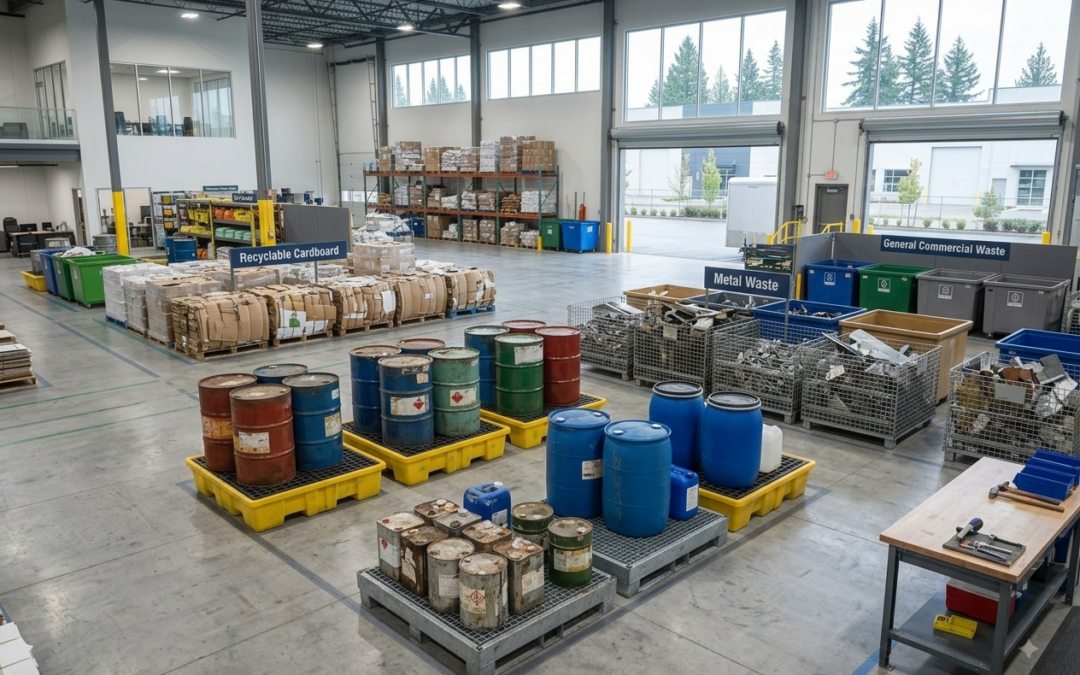
A better approach is to establish separate areas for:
- Recyclable materials
- General commercial waste
- Chemical products
- Unknown containers
- Electronics or batteries
- Other specialized materials
This makes the cleanup easier to control and gives each waste stream a clearer management pathway.
What Should Businesses Do Before Professional Collection?
Preparation should focus on organization and information—not unnecessary handling.
Create an Inventory
List the products and approximate quantities.
Check Documentation
Look for labels, SDS documents, purchasing records, and other identification information.
Keep Materials Separated
Do not combine different chemicals simply to reduce the number of containers.
Inspect Without Unnecessary Handling
Note visible damage, corrosion, leakage, or deterioration without opening containers.
Identify Other Waste Streams
Separate cardboard, metal, plastic, equipment, and general waste from chemical materials.
Communicate Clearly
When arranging collection, explain what is known about the chemicals and disclose any unknown or damaged containers.
These steps can make the removal process more organized and reduce unnecessary handling.
Why Businesses Should Not Wait Until a Warehouse Closure
Unused chemicals often become a bigger problem when a business is preparing to move or close.
During a warehouse relocation, there may already be pressure to clear the property quickly. Employees may discover chemical products only after most of the inventory has been packed.
This can create delays because the business suddenly needs to determine what the materials are and how they should be removed.
A better strategy is to conduct a chemical inventory before the main warehouse cleanout begins.
That gives the business time to identify materials, review documentation, separate waste streams, and arrange appropriate collection.
Turning an Old Chemical Inventory Into a Long-Term Waste Strategy
Discovering years of unused chemicals can also reveal a broader problem with inventory management.
Once the cleanup is complete, businesses can reduce future accumulation by introducing:
- Regular chemical inventory checks
- Better purchasing controls
- Clearly labelled storage
- Accessible SDS records
- Expiry-date monitoring
- Designated chemical storage areas
- Scheduled waste removal
- Employee awareness procedures
The goal is to prevent today’s cleanout problem from becoming tomorrow’s warehouse problem.
A Better Approach for Maple Ridge Warehouses
Finding old chemical products does not mean a business needs to panic or immediately remove everything.
The better approach is controlled assessment.
Identify what is known. Keep materials separated. Protect the integrity of the original containers. Check available documentation. Identify potentially hazardous products. Separate chemicals from recyclable and general commercial waste.
This approach gives the business a clearer picture of what it actually has and what needs to happen next.
Years of unused chemicals can become one of the most complicated parts of a commercial warehouse cleanout, particularly when containers are damaged, labels are missing, or product information is no longer available.
Businesses in Maple Ridge should avoid treating these materials as ordinary garbage or attempting to combine different chemicals for convenience. Instead, inventory the materials, preserve available identification, keep waste streams separated, and arrange professional assistance when specialized handling is required.
At the same time, chemical waste should not overshadow the rest of the warehouse cleanup. Cardboard, metal, plastic, packaging, equipment, and other recoverable materials can often be separated into appropriate recycling streams.
If your Maple Ridge warehouse has accumulated old chemicals, expired products, unknown containers, or other commercial waste, Canadian Empire Recycling & Disposal can help you plan a more organized approach to the cleanup. Contact Canadian Empire Recycling & Disposal to discuss your hazardous waste disposal and commercial recycling requirements and determine the appropriate next step for your facility.