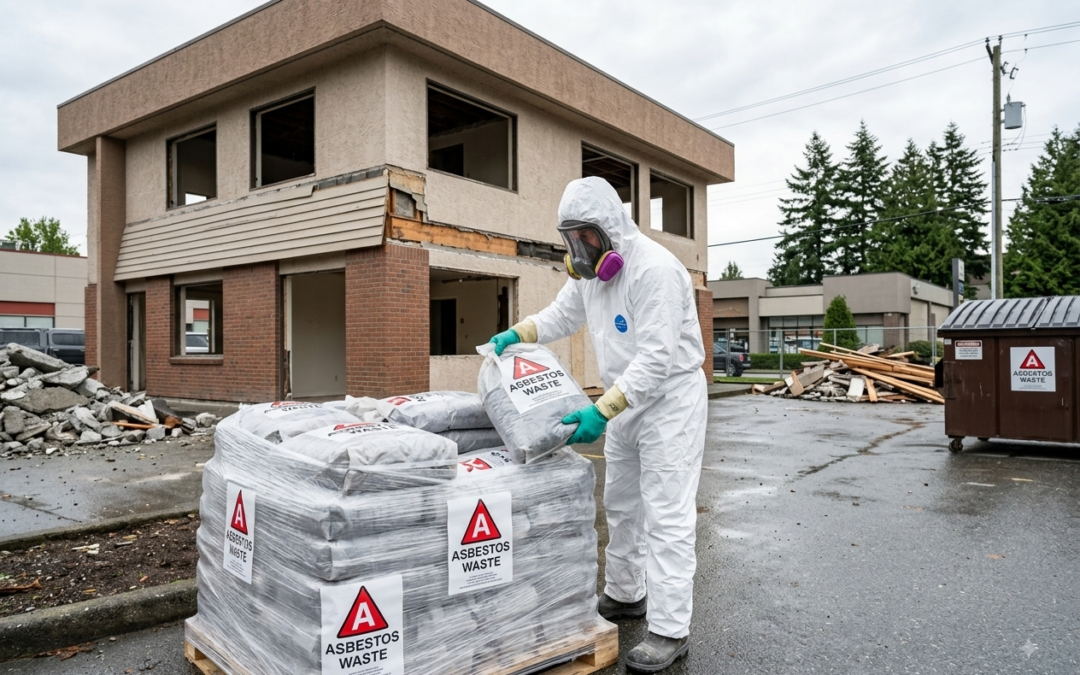
Discovering suspected asbestos during a commercial demolition project can immediately change the way work needs to proceed. What may have started as a straightforward renovation or demolition can become a specialized hazardous-materials project requiring assessment, controlled removal, documentation, and compliant waste handling.
For businesses, property owners, developers, and contractors in Coquitlam, the most important rule is simple: do not treat suspected asbestos as ordinary construction debris.
The City of Coquitlam requires owners and employers to ensure asbestos-containing materials are inventoried and that appropriate risk assessments are completed before demolition. WorkSafeBC also states that suspected asbestos encountered during demolition or renovation requires work to stop until the material is properly assessed and the required controls are implemented.
That makes the next steps especially important.
Quick Answer: What Happens When Asbestos Is Found During Demolition?
If suspected asbestos is discovered during commercial demolition in Coquitlam, work in the affected area should stop and the material should not be disturbed.
The general process involves:
- Stop work around the suspected material.
- Have the material assessed by a qualified professional.
- Complete the required risk assessment and determine the appropriate controls.
- Arrange qualified asbestos abatement where required.
- Ensure asbestos waste is properly contained, labelled, transported, and disposed of.
- Obtain the appropriate documentation or clearance before demolition resumes.
WorkSafeBC guidance explains that if previously unidentified suspected asbestos is encountered during demolition, renovation, or salvage work, work must cease until sampling, identification, and appropriate control measures are completed.
Why Asbestos Changes a Commercial Demolition Project
Commercial demolition creates significant disturbance. Materials that may remain relatively stable during normal building use can become hazardous when cut, broken, drilled, stripped, or demolished.
Asbestos-containing materials can be present in older commercial properties in products such as insulation, flooring materials, pipe insulation, roofing products, cement products, textured materials, and other building components.
WorkSafeBC notes that asbestos was widely used in British Columbia until the early 1990s and can still be found in many areas of older buildings.
The problem is not simply identifying asbestos. Once it is identified or suspected, the project must account for worker protection, containment, removal procedures, waste management, and transportation.
Step 1: Stop Disturbing the Suspected Material
The first response should be to stop work in the affected area.
Workers should not:
- Break the material apart
- Sweep suspected asbestos debris
- Move it into regular construction bins
- Place it with general demolition waste
- Attempt to remove it without appropriate qualifications and controls
WorkSafeBC specifically advises that if asbestos is suspected, it should not be touched or moved and that qualified professionals should handle asbestos removal.
Stopping work early can prevent a localized discovery from becoming a larger contamination and cleanup issue.
Step 2: Identify and Assess the Material
A suspected material needs appropriate assessment before the demolition crew can determine how to proceed.
The assessment process may establish:
- Whether the material contains asbestos
- Where asbestos-containing materials are located
- The condition of the material
- The potential for fibre release
- The appropriate risk classification
- The scope of required abatement
WorkSafeBC requires asbestos inventories and risk assessments where asbestos-containing materials may be disturbed during applicable demolition, alteration, or repair work.
This is particularly important for commercial properties because multiple building systems may contain asbestos-containing materials.
Step 3: Arrange Qualified Asbestos Abatement
If asbestos is confirmed, removal should not simply be added to the demolition crew’s regular scope of work.
WorkSafeBC states that asbestos abatement contractors must be licensed in British Columbia and that workers performing asbestos abatement must have the required certification.
The abatement process can involve specialized containment, work procedures, personal protective equipment, decontamination, waste handling, and air-control measures depending on the material and risk level.
The objective is to prevent asbestos fibres from becoming airborne and spreading beyond the controlled work area.
Step 4: Understand the Notice of Project Requirements
Some asbestos-related demolition and renovation activities require a Notice of Project (NOP) to be submitted to WorkSafeBC before work begins.
WorkSafeBC guidance states that an NOP may be required for moderate- or high-risk asbestos work and certain demolition or renovation activities involving asbestos-containing materials. The applicable notice requirements should be confirmed for the specific project.
For certain asbestos removal work, WorkSafeBC guidance specifies that the NOP is submitted at least 48 hours before work begins.
This is one reason asbestos planning should happen before demolition starts rather than after materials have already been disturbed.
Step 5: Separate Asbestos Waste From Regular Construction Waste
Once asbestos-containing materials are removed, they cannot simply be placed in the same waste stream as ordinary demolition debris.
WorkSafeBC requirements specify that asbestos waste and other waste contaminated with asbestos must be placed into sealed containers labelled as containing asbestos.
This is where the distinction between Commercial Waste Coquitlam and specialized asbestos waste handling becomes important.
General construction waste may include materials such as wood, concrete, metal, packaging, and other debris. Asbestos-contaminated materials require a different handling and disposal process.
Mixing the two waste streams can create unnecessary contamination and compliance problems.
What Can Become Asbestos Waste?
Asbestos waste is not limited to the original building material.
Depending on the project, the waste stream may include:
- Removed asbestos-containing materials
- Contaminated debris
- Disposable protective clothing
- Contaminated cleanup materials
- Contaminated porous materials
- Containment materials
- Dust and debris generated during abatement
WorkSafeBC’s waste-handling requirements specifically address asbestos waste and contaminated materials, including disposable protective clothing and cleanup equipment.
A Coquitlam demolition project therefore needs to consider the entire waste stream, not just the original asbestos-containing product.
Step 6: Use Proper Transportation and Disposal
After containment, asbestos waste needs to move through an appropriate disposal process.
The City of Coquitlam’s demolition guidance states that asbestos-containing materials must be removed and disposed of in accordance with applicable WorkSafeBC, Ministry of Environment waste requirements, and federal transportation requirements. It also states that waste should be transported by a licensed waste disposal company before demolition of the building materials.
This means a commercial project should plan asbestos waste transportation and disposal as part of the project schedule rather than treating it as an afterthought.
For businesses searching for Asbestos Waste Disposal Coquitlam, the key consideration is whether the service can appropriately handle the specific asbestos waste stream and required documentation.
Step 7: Keep the Documentation Organized
Commercial demolition projects can involve several layers of documentation.
Depending on the project, records may include:
- Asbestos inventory
- Risk assessment
- Abatement documentation
- Notice of Project
- Waste documentation
- Transportation records
- Clearance documentation
- Disposal records
The City of Coquitlam’s demolition permit materials specifically reference a clearance letter and waste manifest documentation in its asbestos abatement process.
Keeping these records organized helps property owners, contractors, consultants, and project managers demonstrate that asbestos-related work was handled through the appropriate process.
Step 8: Confirm the Site Is Ready for Demolition to Continue
Finding asbestos does not necessarily mean the entire commercial demolition project must stop indefinitely.
Instead, the affected work needs to be properly assessed and managed.
After required abatement and verification are completed, the project can move toward the next stage according to the applicable requirements.
WorkSafeBC’s demolition guidance describes a process in which asbestos is identified, safely contained or removed, written confirmation is obtained, and only then can the owner authorize demolition or renovation work to proceed.
This creates a clear separation between asbestos abatement and general demolition.
Why Commercial Properties Require Extra Planning
Commercial buildings can contain multiple layers of construction materials from different renovation periods.
A property may have:
- Original construction materials
- Older insulation
- Later flooring installations
- Multiple ceiling systems
- Mechanical upgrades
- Previous renovations
- Older roofing or exterior materials
As a result, one asbestos discovery can lead to additional investigation elsewhere in the building.
This is why a comprehensive asbestos inventory before major demolition is far more effective than relying on visual inspection during the demolition itself.
How Asbestos Affects the Commercial Waste Schedule
Asbestos discovery can change the project’s timeline.
A demolition contractor may have equipment and crews scheduled for specific dates, while asbestos abatement requires a separate process involving assessment, planning, containment, removal, transportation, and disposal.
If waste disposal is not arranged early, removed materials can remain onsite longer than planned.
A better approach is to coordinate:
Assessment → Abatement → Waste Containment → Transportation → Disposal → Documentation → Demolition
This creates a more predictable workflow and reduces the risk of mixing asbestos waste with regular commercial debris.
What Should Coquitlam Businesses Never Do?
Commercial property owners and contractors should avoid several common mistakes.
Do Not Assume Old Material Is Safe
You cannot reliably identify asbestos simply by looking at a material. WorkSafeBC recommends assessment by qualified professionals when asbestos is suspected.
Do Not Put Asbestos Into a Regular Bin
Asbestos waste requires appropriate containment and labelling.
Do Not Let General Demolition Crews Disturb Suspected Asbestos
If suspected asbestos is encountered, work should stop until the required assessment and controls are completed.
Do Not Treat Disposal as the Final-Minute Task
Transportation and disposal need to be coordinated with the abatement schedule.
Do Not Ignore Documentation
Commercial projects should maintain appropriate records throughout the asbestos process.
Asbestos Waste vs. General Commercial Waste
Understanding the difference helps businesses plan their waste management correctly.
| Waste Stream | Typical Examples | Handling Approach |
| General commercial waste | Packaging, non-contaminated debris, office waste | Regular commercial waste stream |
| Construction waste | Wood, concrete, metal, non-contaminated materials | Appropriate construction recycling/disposal stream |
| Asbestos waste | Asbestos-containing materials and contaminated debris | Specialized containment, transportation and disposal |
The important point is that Commercial Waste Recycling Coquitlam does not automatically mean every material from a commercial demolition site can enter the same waste stream.
When asbestos is involved, specialized procedures apply.
Planning Asbestos Disposal Before Demolition Starts
The easiest way to manage asbestos waste disposal is to plan for it before demolition begins.
Before the first wall is removed, project managers should understand:
- Whether asbestos-containing materials have been identified
- Which materials require abatement
- Who is responsible for removal
- How waste will be contained
- How waste will be transported
- Where it will be accepted
- What documentation is required
- When demolition can safely resume
This planning approach can reduce unexpected delays and help keep the project organized.
When asbestos is found during commercial demolition in Coquitlam, the right response is not to move it into the nearest construction bin and continue working. The affected area should be controlled, the material properly assessed, and qualified asbestos professionals should manage required abatement.
The resulting waste must then be properly contained, labelled, transported, and disposed of through the appropriate waste-management process. WorkSafeBC emphasizes the importance of asbestos assessment, safe removal, compliant waste handling, and documentation before demolition proceeds.
If your commercial renovation or demolition project has generated asbestos-containing materials, Canadian Empire Recycling & Disposal can help businesses coordinate specialized waste disposal requirements. Contact Canadian Empire Recycling & Disposal to discuss your Asbestos Waste Disposal needs and ensure your commercial waste stream is planned appropriately from the worksite through final disposal.