
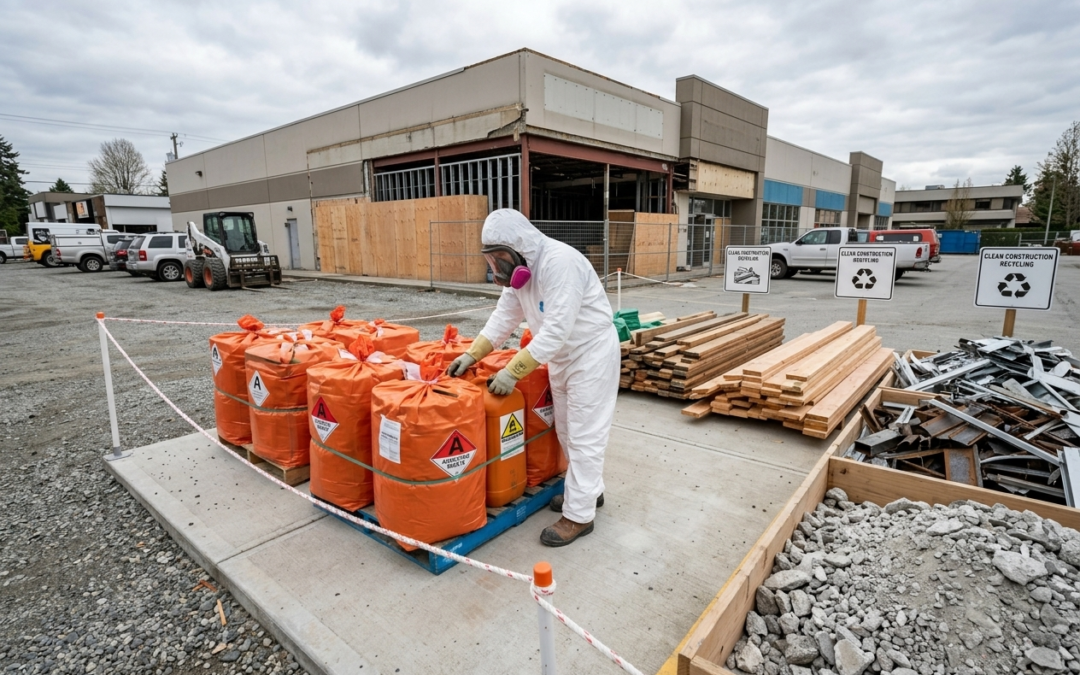
Commercial renovation and demolition projects are usually planned around tight schedules. Crews are booked, equipment is arranged, materials are ordered, and property owners expect work to move from one stage to the next without unnecessary interruptions. But when asbestos-containing materials are discovered and the waste has not been properly planned for, a project can quickly lose that momentum.
For businesses and contractors in Port Coquitlam, asbestos waste is not simply another category of construction debris. It requires specialized handling, containment, transportation, and disposal procedures. Poor planning can create delays that affect demolition schedules, labour, site access, waste removal, and overall project costs.
Understanding where asbestos waste fits into the demolition workflow can help commercial property owners avoid preventable disruptions.
Quick Answer: Why Can Poor Asbestos Waste Planning Delay a Project?
Poor asbestos waste planning can create delays because asbestos-related work may require additional assessment, controlled removal, specialized waste containment, transportation arrangements, and appropriate disposal documentation.
Common causes of delays include:
- Discovering asbestos after demolition has already started
- Failing to arrange asbestos assessment in advance
- Mixing asbestos waste with regular construction debris
- Not having suitable waste containers available
- Delaying transportation arrangements
- Missing required project documentation
- Underestimating the volume of asbestos-containing waste
- Scheduling demolition before asbestos abatement is complete
WorkSafeBC requires asbestos-containing materials to be properly identified and managed before they are disturbed during applicable demolition, renovation, or repair activities. If previously unidentified suspected asbestos is discovered, work may need to stop until appropriate assessment and controls are in place.
Why Asbestos Waste Planning Should Start Before Demolition
One of the biggest mistakes commercial projects can make is treating asbestos as an unexpected waste problem rather than a pre-demolition planning issue.
Older commercial buildings can contain asbestos in various materials, including insulation, flooring products, cement products, roofing materials, pipe insulation, and other building components.
If demolition begins before these materials are properly identified, workers may encounter unexpected asbestos-containing materials halfway through the project.
That can change the entire sequence of work.
Instead of:
Demolition → Waste Removal → Recycling/Disposal
the project may suddenly need:
Stop Work → Assessment → Abatement → Containment → Waste Transportation → Disposal → Clearance → Demolition
Each additional stage can affect the original schedule.
Delay #1: Discovering Asbestos After Demolition Begins
Finding suspected asbestos after demolition has started is one of the easiest ways to disrupt a commercial project.
A demolition crew may already be scheduled to remove walls, flooring, ceilings, mechanical systems, or other components. If an unexpected material is identified as potentially containing asbestos, work around the affected area may need to stop until the material is properly assessed.
This can leave:
- Workers waiting
- Equipment sitting idle
- Disposal bins underused
- Contractors rescheduling crews
- Other trades unable to access the area
- Project managers revising timelines
The delay can become even greater when the discovery affects materials that were not included in the original scope.
Delay #2: Waiting for Asbestos Assessment
Suspected asbestos should not be disturbed simply because it looks similar to a material that has already been tested.
Appropriate assessment helps determine whether asbestos is present and how the material should be managed.
For commercial projects, this is why an asbestos inventory and assessment should ideally happen before major demolition begins.
WorkSafeBC guidance emphasizes asbestos inventories and risk assessments where asbestos-containing materials may be disturbed.
Planning the assessment early gives the project team a better understanding of the potential scope of asbestos-related work.
Delay #3: Scheduling Specialized Abatement
If asbestos is confirmed, removal may require qualified asbestos professionals rather than the regular demolition crew.
WorkSafeBC states that asbestos abatement contractors must be licensed in British Columbia and workers performing asbestos abatement must meet applicable certification requirements.
If no abatement contractor has been scheduled, the demolition project may have to wait for:
- Contractor availability
- Site preparation
- Containment
- Removal
- Cleanup
- Required verification
This is why asbestos planning should happen alongside the demolition schedule rather than after demolition has already started.
Delay #4: No Specialized Waste Container Available
Asbestos waste cannot simply be placed into an ordinary construction bin.
Asbestos waste and materials contaminated with asbestos must be appropriately contained and labelled.
If the project discovers asbestos but has only arranged standard construction bins, the waste cannot simply be added to those containers.
The project may then have to wait for appropriate containers or revise its waste-management plan.
For contractors researching Asbestos Waste Disposal Port Coquitlam, container availability should therefore be discussed before asbestos removal begins.
Delay #5: Mixing Asbestos Waste With General Construction Debris
Commercial demolition can generate large quantities of wood, concrete, drywall, metal, packaging, and other materials.
Some of these materials may be recyclable through a Commercial Waste Recycling Port Coquitlam program when they are not contaminated.
Asbestos-containing materials, however, require a separate waste-management approach.
Mixing the two streams can create additional handling and disposal complications. It may also reduce opportunities to recycle otherwise recoverable commercial construction materials.
A better approach is to establish separate waste streams from the beginning.
Example
A demolition project might separate:
- Clean metal → recycling
- Clean cardboard → recycling
- Clean wood → appropriate recovery/recycling stream
- Concrete → suitable construction recycling stream
- General debris → appropriate disposal
- Asbestos-containing materials → specialized asbestos waste stream
This separation makes the waste plan more predictable and can prevent one hazardous material from disrupting the management of all other waste.
Delay #6: Underestimating the Amount of Asbestos Waste
A project may identify one asbestos-containing product and assume the quantity will be small.
But once abatement begins, additional contaminated materials or related waste can sometimes become part of the controlled waste stream.
Depending on the project, asbestos waste may include:
- Removed asbestos-containing materials
- Contaminated debris
- Disposable protective clothing
- Cleanup materials
- Contaminated equipment or materials
- Containment materials
WorkSafeBC requirements address asbestos waste and materials contaminated with asbestos, including certain disposable protective clothing and cleanup equipment.
If the project has not planned sufficient containment or transportation capacity, additional waste can remain onsite longer than expected.
Delay #7: Transportation Is Not Arranged in Advance
Removing asbestos from a commercial property is only one part of the process.
The waste must also be transported through an appropriate process to an authorized disposal destination.
The City of Port Coquitlam provides information for demolition projects and directs applicants to applicable requirements for hazardous materials and waste management.
For a busy commercial site, leaving transportation arrangements until the waste is already generated can create unnecessary downtime.
Project managers should coordinate:
Removal → Containment → Pickup → Transportation → Disposal
before the work begins.
Delay #8: Documentation Problems
Commercial demolition projects often involve multiple parties:
- Property owners
- General contractors
- Demolition contractors
- Asbestos consultants
- Abatement contractors
- Waste service providers
- Transportation providers
- Disposal facilities
If responsibilities are unclear, important documentation can be delayed or misplaced.
Depending on the project, records may include asbestos assessments, inventories, abatement documentation, waste manifests, disposal records, and clearance documentation.
Maintaining a clear document trail helps project managers know exactly what has been completed and what remains outstanding.
Delay #9: Demolition and Asbestos Work Are Scheduled in the Wrong Order
A commercial project may have multiple trades scheduled in sequence.
For example:
Week 1: Site preparation
Week 2: Asbestos abatement
Week 3: Demolition
Week 4: Structural work
Week 5: Mechanical and electrical work
If asbestos is discovered unexpectedly during Week 3, the entire sequence can shift.
Electrical, plumbing, HVAC, framing, flooring, and other trades may have to wait because they cannot access the affected area.
This is why asbestos should be addressed before major demolition whenever there is a reasonable possibility of exposure.
How Better Waste Planning Protects the Commercial Schedule
A well-planned asbestos waste strategy should answer several questions before work begins:
1. Where is the asbestos?
The project should have appropriate information about known or suspected asbestos-containing materials.
2. Who will remove it?
Responsibilities should be clearly assigned to appropriately qualified professionals.
3. Where will the waste go?
The disposal route should be established before material is removed.
4. How will it be contained?
Suitable packaging, containers, labelling, and site procedures should be planned.
5. When will it be transported?
Pickup and transportation should align with the abatement schedule.
6. What happens to the remaining construction waste?
Clean materials should be kept separate where practical so that recyclable materials can remain within the appropriate recovery stream.
This last step is especially important for businesses trying to improve Commercial Waste Recycling outcomes while managing hazardous materials separately.
Asbestos Waste Planning Can Also Improve Overall Waste Management
Asbestos planning is not only about preventing delays.
It can also improve the broader waste strategy for a commercial project.
When hazardous materials are identified and isolated early, the remaining construction waste can often be managed more efficiently.
Instead of sending mixed debris into one disposal stream, contractors can organize materials into appropriate categories.
For example:
| Material | Potential Management Route |
| Clean metal | Recycling |
| Clean cardboard | Recycling |
| Clean concrete | Construction recycling |
| Clean wood | Recovery/recycling where accepted |
| General non-hazardous debris | Appropriate disposal |
| Asbestos-containing materials | Specialized asbestos waste disposal |
This approach can help prevent recyclable materials from becoming unnecessarily mixed with hazardous waste.
How Port Coquitlam Businesses Can Reduce Asbestos-Related Delays
A practical approach is to create an asbestos waste plan before demolition begins.
Pre-Demolition Checklist
Before work starts:
- Review the building’s age and renovation history.
- Arrange appropriate asbestos assessment.
- Identify affected areas.
- Confirm who is responsible for abatement.
- Establish the required waste stream.
- Arrange appropriate containers.
- Confirm transportation arrangements.
- Confirm the intended disposal process.
- Organize project documentation.
- Coordinate the schedule between abatement and demolition.
This may take additional planning time at the beginning, but it can prevent significantly larger disruptions later.
What If Asbestos Is Discovered Unexpectedly?
If suspected asbestos is discovered after work begins, the priority should be safety and proper assessment rather than trying to keep the demolition schedule moving.
The affected area should be controlled, the material assessed, and the required procedures established before disturbing it further.
Do not:
- Break the material
- Sweep suspected asbestos debris
- Place it in a regular bin
- Transport it without appropriate arrangements
- Ask unqualified workers to remove it
WorkSafeBC guidance states that suspected asbestos encountered during demolition or renovation should be assessed and controlled before work continues.
The Cost of Poor Planning Goes Beyond Waste Disposal
A poorly planned asbestos waste process can create several indirect costs.
Labour Costs
Workers may be unable to continue their scheduled tasks.
Equipment Costs
Demolition equipment may remain onsite while work is paused.
Scheduling Costs
Trades may need to be rescheduled, potentially affecting the entire project.
Storage Costs
Waste may remain onsite until suitable transportation is arranged.
Administrative Costs
Additional documentation and coordination may be required after an unexpected discovery.
Opportunity Costs
A delayed commercial property may remain unavailable to tenants, customers, employees, or other users for longer than expected.
The actual disposal charge is therefore only one part of the potential financial impact.
Choosing the Right Waste Partner
When planning Asbestos Waste Disposal Port Coquitlam, businesses should look beyond simply finding a company that can remove a bin.
The waste provider should be able to clearly explain:
- What type of asbestos waste they accept
- How the waste must be packaged
- What container is appropriate
- How pickup is coordinated
- How transportation is handled
- What documentation is provided
- Where the waste is taken for disposal
For commercial projects, clear communication between the abatement contractor, demolition contractor, and waste provider can make the overall process significantly easier to manage.
Poor asbestos waste planning can turn a carefully scheduled commercial renovation or demolition into a project full of unexpected pauses. The biggest risks usually arise when asbestos is discovered too late, specialized abatement has not been scheduled, suitable containers are unavailable, transportation has not been arranged, or hazardous waste becomes mixed with regular construction debris.
The solution is proactive planning.
By identifying asbestos before demolition, arranging qualified abatement, separating hazardous waste from recyclable materials, and coordinating containment, transportation, and disposal in advance, Port Coquitlam businesses can reduce avoidable disruptions and keep their commercial projects more organized.
If your renovation or demolition project requires Asbestos Waste Disposal, Canadian Empire Recycling & Disposal can help you plan the appropriate waste-management process for asbestos-containing materials and other commercial waste streams. Contact Canadian Empire Recycling & Disposal to discuss your project requirements and coordinate waste disposal before asbestos-related delays affect your schedule.