Commercial space is valuable, especially when a business is paying for every square foot. Yet many Mission businesses have equipment, furniture, packaging, outdated inventory, renovation debris, and unused materials occupying areas that could otherwise support daily operations.
Commercial junk does not always appear as a major problem at first. A few broken office chairs, an old filing cabinet, unused shelving, or outdated equipment can gradually turn into a storage area that is difficult to manage.
For commercial property owners and business operators in Mission, identifying what can be removed, recycled, or redirected can help create a more functional workplace without unnecessarily sacrificing usable space.
Why Commercial Junk Accumulates
Business junk usually builds up gradually rather than appearing all at once.
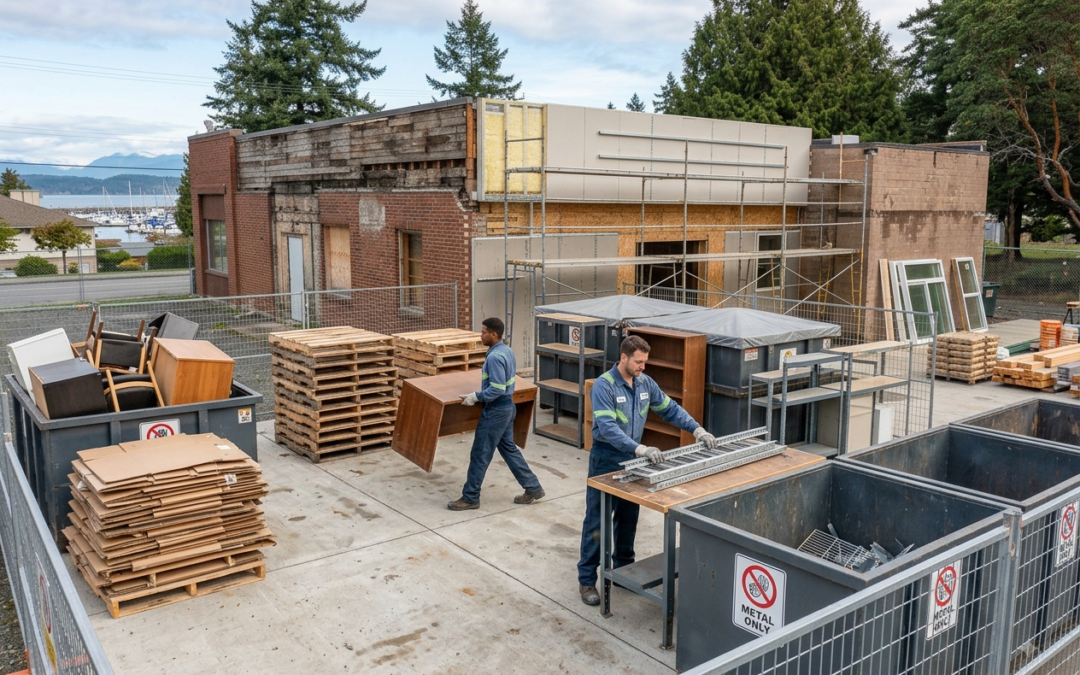
A company may replace office furniture but keep the old pieces “just in case.” A warehouse may retain damaged pallets or outdated inventory. A retail location may store old displays after a renovation. A contractor may finish a project and leave behind materials that are no longer required.
Over time, these items can occupy storage rooms, loading areas, garages, warehouse corners, and other commercial spaces.
The issue is not always the amount of junk. It is the value of the space being occupied by items that no longer serve a business purpose.
What Types of Junk Take Up the Most Commercial Space?
Different businesses generate different types of unwanted materials, but several categories are particularly common.
1. Outdated Office Furniture
Desks, chairs, filing cabinets, reception counters, shelving, and conference furniture can take up substantial space after an office redesign.
If the furniture is no longer needed, keeping it indefinitely can turn valuable floor space into long-term storage.
2. Broken or Obsolete Equipment
Commercial properties often accumulate equipment that is no longer operational or compatible with current systems.
Examples may include:
- Old appliances
- Damaged machinery
- Outdated office equipment
- Broken fixtures
- Unused tools
- Old display equipment
Before removing equipment, businesses should determine whether it contains components requiring specialized handling.
3. Renovation Debris
Commercial renovations can produce significant quantities of unwanted materials.
Old cabinets, flooring, drywall, fixtures, doors, shelving, and other construction materials can remain on-site after contractors have completed their work.
Without a removal plan, renovation debris can quickly consume storage and work areas.
4. Outdated Inventory
Retailers, warehouses, and distributors may eventually have inventory that is damaged, obsolete, expired, or no longer commercially useful.
Holding these materials indefinitely can create storage costs while reducing the amount of space available for current inventory.
5. Packaging and Shipping Materials
Businesses that receive or ship products can accumulate cardboard, pallets, plastic packaging, crates, and other materials.
Some of these materials may be recyclable, while others may require different disposal options.
When Does Business Storage Become Commercial Junk?
One useful question for business owners is:
Would this item realistically be used again?
If the answer is no, the item may no longer belong in valuable operational space.
Businesses can review stored materials based on factors such as:
- Condition
- Frequency of use
- Replacement cost
- Storage requirements
- Business relevance
- Recycling potential
- Disposal requirements
This does not mean every unused item should immediately be thrown away. Some materials may have resale, donation, reuse, or recycling value.
The goal is to identify items that are occupying commercial space without providing meaningful value.
Commercial Waste Recycling Mission: What Can Be Recovered?
Before sending everything for disposal, businesses should consider whether some materials can be recycled or recovered.
Commercial Waste Recycling Mission can play an important role in reducing the amount of business waste that ultimately requires disposal.
Depending on the material and its condition, recyclable streams may include:
- Scrap metal
- Cardboard
- Certain plastics
- Wood
- Paper
- Appliances and equipment with recoverable components
- Other commercially recyclable materials
Not every item belongs in the same recycling stream, so materials should be separated appropriately.
For businesses clearing a warehouse, office, retail property, or commercial facility, separating recyclable materials from general junk can make the cleanup process more efficient.
Why Keeping Unused Junk Can Cost More Than You Think
Commercial junk can create indirect costs beyond the actual cost of removal.
Lost Floor Space
Every area used for unwanted materials is an area that cannot be used for inventory, equipment, employees, customers, or operations.
Reduced Organization
Crowded storage areas make it harder for employees to find the materials they actually need.
Additional Handling
When junk is moved repeatedly from one part of a building to another, employees spend time handling items that provide little business value.
Safety and Accessibility Concerns
Excessive clutter can make walkways, storage areas, loading zones, and workspaces more difficult to navigate.
Delayed Renovation or Expansion
A business may be ready to renovate or repurpose an area but first needs to clear years of accumulated materials.
How Mission Businesses Can Identify Space-Wasting Junk
A practical commercial cleanout can begin with a room-by-room assessment.
Start with areas that are rarely used. Storage rooms, back offices, warehouses, garages, basements, loading areas, and unused sections of commercial properties often reveal the largest accumulation of unwanted items.
For each item, ask:
Is it being used?
If yes, keep it.
Will it realistically be used in the near future?
If uncertain, consider whether the storage cost and space are justified.
Can it be reused or transferred elsewhere?
If yes, determine whether another department or location can use it.
Can it be recycled?
If the material has recycling potential, separate it from general junk.
Does it require specialized handling?
Certain electronics, chemicals, batteries, appliances, or other materials should not automatically be treated as ordinary commercial garbage.
This simple process can help businesses make better decisions before arranging a large cleanout.
When Professional Junk Removal Makes Sense
Some commercial cleanouts are too large for employees to handle efficiently.
A business relocation, office renovation, warehouse cleanout, property turnover, or major inventory reduction can generate far more junk than can reasonably be handled through regular garbage collection.
This is where Junk Removal Services Mission can help businesses manage larger quantities of unwanted materials.
Professional removal can be particularly useful when items are bulky, heavy, numerous, or spread across multiple areas of a commercial property.
Instead of asking employees to spend valuable working hours moving unwanted furniture, equipment, and debris, businesses can coordinate a dedicated removal service around their operating schedule.
Preparing for a Commercial Junk Removal Project
Before a scheduled cleanout, businesses can make the process more efficient by identifying what needs to go.
Create separate areas for:
- Items to keep
- Items to reuse
- Recyclable materials
- General junk
- Materials requiring specialized handling
Clearly identifying these categories can reduce confusion during removal.
Businesses should also check whether any equipment contains batteries, refrigerants, chemicals, electronic components, or other materials that may require a different disposal process.
Commercial Cleanouts Can Create More Than Physical Space
Removing unwanted junk can have an operational benefit as well.
A cleaner storage area can make inventory easier to organize. An empty office can be repurposed. A cleared warehouse corner can accommodate new stock. A renovated commercial unit can become ready for its next tenant.
The benefit is therefore not simply having “less junk.”
It is recovering space that the business can actually use.
For commercial property owners, this can be particularly important when every available square foot contributes to productivity or revenue.
A Smarter Approach to Commercial Junk
Businesses do not need to wait until a storage room becomes full before taking action.
A periodic commercial cleanout can help prevent unwanted items from accumulating over several years. After a renovation, relocation, equipment upgrade, or inventory change, businesses can review what remains and determine what is still useful.
Combining reuse, recycling, and appropriate removal can create a more sustainable approach than sending everything directly to landfill.
It also helps businesses maintain better control over their commercial spaces.
Commercial junk can quietly consume valuable space in Mission properties, from unused office furniture and outdated equipment to renovation debris and obsolete inventory. A regular review can help businesses identify what should be kept, reused, recycled, or removed.
If your Mission commercial property has accumulated unwanted furniture, equipment, debris, or other business junk, Canadian Empire Recycling & Disposal can help with the next step. Contact Canadian Empire Recycling & Disposal to discuss your commercial cleanout and find a practical solution for Junk Removal Services Mission.