
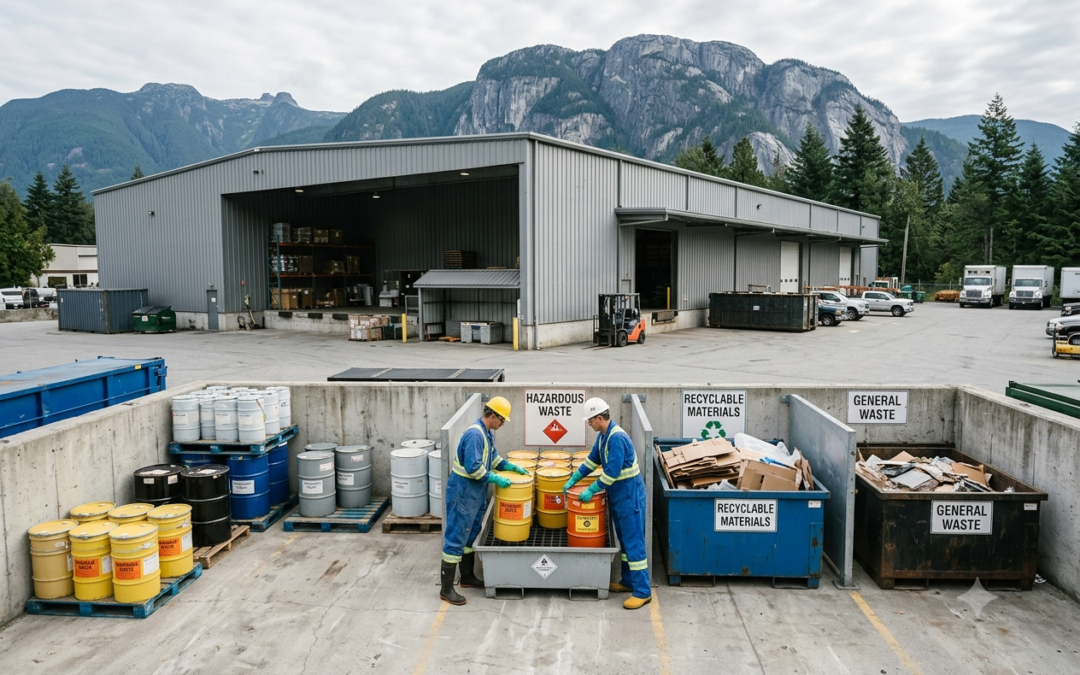
Commercial businesses in Squamish can accumulate chemical products through everyday operations, maintenance, cleaning, construction, manufacturing, landscaping, and other activities. Over time, businesses may end up with expired products, leftover chemicals, damaged containers, or substances that are no longer needed.
The challenge is that unwanted chemicals should not automatically be treated as ordinary commercial garbage. Their properties, condition, quantity, and intended use can determine how they should be handled and where they can be taken for appropriate disposal.
For businesses preparing a renovation, relocation, property cleanout, or operational change, identifying unwanted chemicals early can make the overall waste-management process safer and more organized.
Why Unwanted Commercial Chemicals Need Special Attention
Commercial chemicals can include a wide range of products, from cleaning agents and solvents to paints, coatings, degreasers, oils, and industrial products.
Some substances may be flammable, corrosive, reactive, toxic, or otherwise require specialized handling. Even a product that was originally purchased for routine business use can become a waste-management concern once it is expired, contaminated, damaged, or no longer required.
Simply placing chemical containers into general waste can create risks for workers, collection crews, transportation personnel, and disposal facilities.
The first step is therefore to identify what the business has before deciding how it should be removed.
What Types of Commercial Chemicals May Become Waste?
Different industries can generate different chemical waste streams. Common examples can include:
- Cleaning chemicals
- Solvents and degreasers
- Paints and coatings
- Adhesives and sealants
- Oils and petroleum-based products
- Pesticides
- Chemical treatment products
- Laboratory chemicals
- Automotive fluids
- Industrial maintenance chemicals
This list is not exhaustive, and the correct handling method depends on the characteristics of each product.
Businesses should avoid assuming that two containers can be managed in the same way simply because both are labelled as cleaning or maintenance products.
1. Start by Taking Inventory
Before arranging collection, businesses should identify the chemical products present on the property.
An inventory can include:
- Product name
- Manufacturer information
- Container size
- Approximate quantity
- Condition of the container
- Expiry information where available
- Safety information or product documentation
This information can help determine which products require specialized handling and which may have an alternative recovery or recycling route.
An inventory is particularly useful during large commercial cleanouts because employees may discover chemicals in multiple storage locations.
2. Check Labels Before Moving Containers
Labels can provide valuable information about the product and its potential hazards.
Businesses should look for product names, hazard symbols, handling instructions, and other available information.
However, an old or partially damaged label may not provide enough information to safely determine how a substance should be managed.
Unlabelled containers should not be treated as harmless simply because their contents look familiar.
If the identity of a chemical cannot be established, businesses should seek appropriate professional guidance before opening, mixing, or unnecessarily moving the container.
3. Never Mix Unwanted Chemicals
One of the most important rules for commercial chemical waste is to avoid mixing different substances.
Combining chemicals can create unexpected reactions, produce hazardous vapours, generate heat, or make the resulting waste more difficult to classify and handle.
Even products that appear similar can have different chemical properties.
Keep containers separated and in their original packaging where practical, provided the packaging remains suitable and safe.
4. Pay Attention to Damaged or Leaking Containers
A chemical container that is cracked, corroded, swollen, leaking, or otherwise damaged requires additional attention.
Businesses should not attempt to solve the problem by casually transferring the substance into another container or disposing of it with ordinary garbage.
A leaking container can create exposure and contamination concerns, particularly in enclosed storage rooms or areas with heavy foot traffic.
The appropriate response depends on the material and the circumstances, so businesses should seek qualified guidance when a container is damaged or leaking.
5. Keep Chemical Waste Separate From General Waste
Commercial properties often generate several waste streams at the same time.
A business cleanout might involve cardboard, furniture, scrap metal, packaging, equipment, construction debris, and chemical products.
Keeping these materials separate makes it easier to determine the appropriate recycling or disposal route for each category.
For businesses arranging Commercial Waste Disposal Squamish, separating chemical products before collection can help prevent specialized materials from being mixed into general commercial waste.
It also provides the waste-management provider with a clearer understanding of what needs to be collected.
6. Don’t Assume Every Chemical Can Go to the Same Drop-Off Location
Businesses sometimes assume that because a facility accepts hazardous products from residents, it will automatically accept commercial quantities or every type of chemical.
That assumption can lead to rejected loads and unnecessary transportation.
Before taking commercial chemical waste anywhere, businesses should confirm that the receiving facility or service accepts:
- The specific chemical
- The quantity involved
- The type of commercial source
- The condition of the material
- The required packaging or containment
For larger volumes, arranging a commercial waste-management service may be more appropriate than transporting multiple containers independently.
7. Plan for Commercial Renovations
Renovation projects can uncover chemicals that have been stored on a property for years.
Contractors may find old paint, solvents, adhesives, cleaning products, oils, or maintenance chemicals behind equipment or inside storage areas.
If these materials are discovered after demolition has already started, the project may need to pause while an appropriate management solution is arranged.
Including chemical waste identification in the pre-renovation planning stage can reduce this risk.
8. Commercial Relocations Can Reveal Hidden Chemical Waste
Business relocations are another situation where unwanted chemical products often surface.
When employees are packing offices, workshops, storage rooms, and maintenance areas, they may discover products that have not been used for years.
Instead of treating these products as ordinary unwanted inventory, businesses should review them before disposal.
A relocation cleanout provides an opportunity to separate recyclable materials, reusable products, general waste, and specialized waste before everything leaves the property.
9. Consider the Condition of the Chemical
The same product can present different waste-management concerns depending on its condition.
For example, a sealed container with a clearly identifiable product may be easier to manage than a damaged, leaking, or unlabelled container.
Businesses should therefore provide accurate information about the condition of their chemical waste when arranging collection.
This allows the waste-management provider to understand the situation and determine the appropriate handling requirements.
What Should Businesses Do With Expired Chemicals?
Expired does not necessarily mean that a chemical has become harmless.
Some products can remain hazardous even after their intended shelf life has passed. Others may deteriorate over time or become unsuitable for their original purpose.
Businesses should not pour expired chemicals down drains, place them in regular garbage, or combine them with other products simply because they are no longer useful.
Instead, identify the product and arrange the appropriate management route based on its characteristics.
Chemical Waste During Property Cleanouts
A commercial property cleanout can generate a surprisingly diverse waste stream.
A warehouse may contain old maintenance chemicals, while an office may have cleaning products and batteries. A workshop could have solvents and oils, while a retail or industrial property may have coatings or other specialized products.
This is why a pre-cleanout inspection is valuable.
Before workers begin removing large amounts of material, property managers can identify chemical storage areas and separate potentially hazardous products from ordinary debris.
This makes the cleanup more predictable and reduces the possibility of unsuitable materials being loaded together.
How Proper Chemical Waste Planning Supports Recycling
Hazardous waste disposal does not mean every item from a commercial cleanout has to be discarded.
Many businesses generate materials that can be recycled or recovered when properly separated.
For example, scrap metal, cardboard, certain plastics, and other materials may have recycling opportunities. Keeping these materials away from chemical waste can improve the overall quality of recyclable loads.
Effective waste planning therefore involves more than removing unwanted materials. It involves identifying which materials can be recovered and which require specialized disposal.
Common Mistakes Squamish Businesses Should Avoid
Pouring Chemicals Down Drains
Commercial chemicals should not be disposed of through sinks, storm drains, or other drainage systems simply because they are no longer needed.
Placing Chemical Containers in General Garbage
A commercial garbage container is not automatically appropriate for chemical products.
Mixing Different Products
Combining chemicals can create dangerous reactions and complicate waste classification.
Ignoring Old Containers
A product that has been sitting unused for years should still be identified before disposal.
Transporting Unknown Chemicals Without Checking Requirements
Businesses should understand what they are transporting and whether the receiving service accepts the material before moving it.
Waiting Until the Last Minute
Finding chemical waste on the final day of a property cleanout can create unnecessary delays.
A Better Approach to Commercial Chemical Waste
A simple planning process can make chemical waste management much more organized:
Identify → Separate → Document → Confirm → Collect → Dispose
First, identify the chemical products present. Then separate them from general waste and recyclable materials. Document product information where available, confirm the appropriate management route, and arrange collection before the cleanout or renovation begins.
This approach helps businesses avoid treating all waste as one category.
Why Local Waste Planning Matters in Squamish
Squamish businesses operate across a diverse range of commercial and industrial environments. A small office cleanout can have very different waste requirements from a workshop, warehouse, construction site, or industrial property.
Local businesses should therefore consider the specific materials present at their property rather than relying on a generic disposal plan.
Advance coordination also allows businesses to ask about accepted materials, preparation requirements, collection arrangements, and appropriate disposal routes.
Unwanted commercial chemicals should be treated as a separate waste-management concern rather than being mixed with ordinary business garbage. Identifying products, keeping containers separated, avoiding chemical mixing, and arranging the appropriate disposal route can help businesses manage cleanouts and renovations more efficiently.
If your business has unwanted chemicals or other specialized materials that need to be removed, Canadian Empire Recycling & Disposal can help you plan an appropriate waste-management solution. Contact Canadian Empire Recycling & Disposal to discuss your commercial waste requirements and arrange the right service for your Squamish property.